

Have you ever looked at the narrative arc? With odd terms like conflict, climax and closure? And thought: ok, but what do I actually do with this?
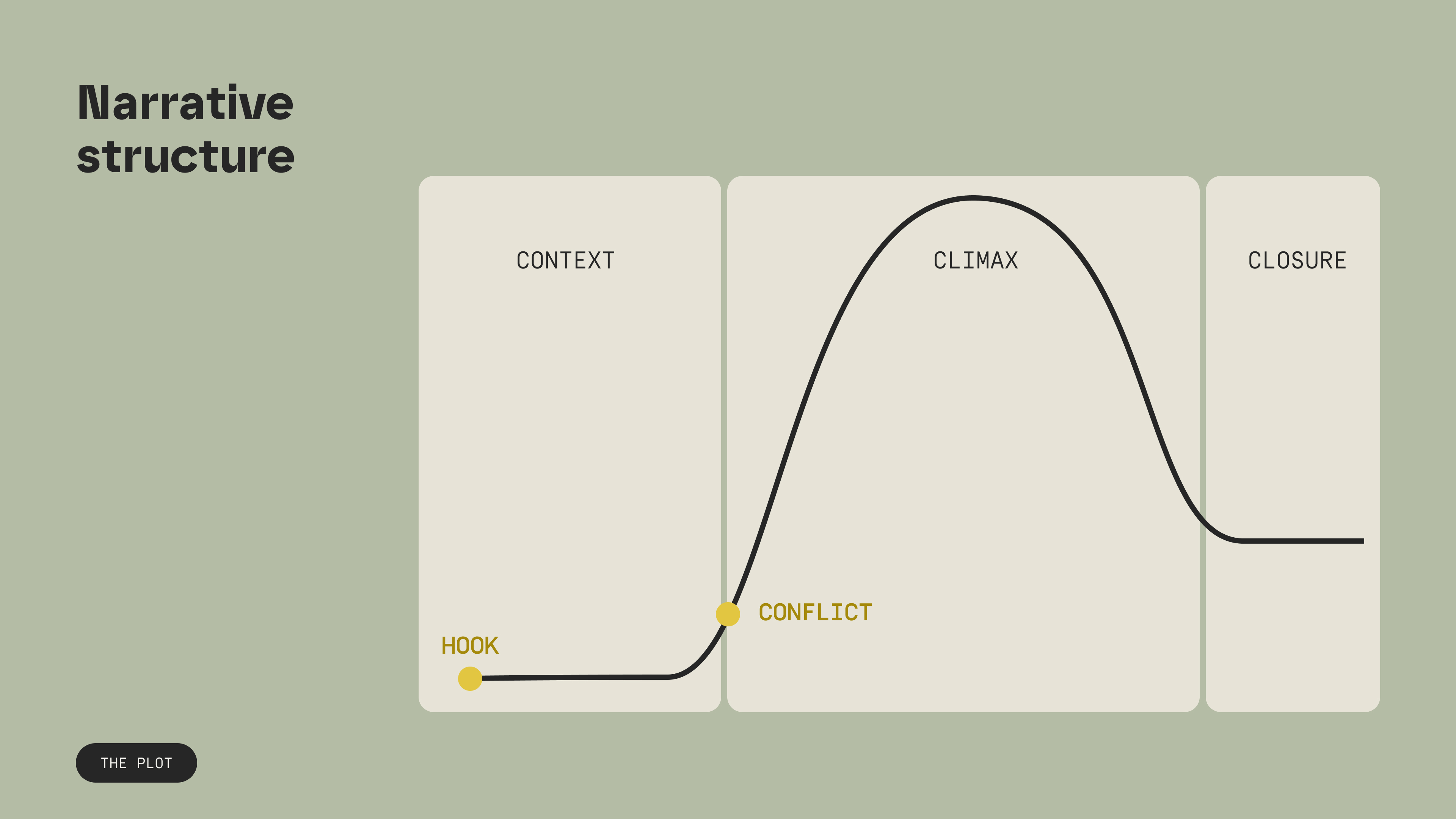
Let’s break it down through the lens of a real project: the AI Disruption Index we recently worked on with Moloco and BCG.
Start with the conflict
For a story to be interesting, there needs to be conflict. An event that shatters the status quo and grips the reader: what will happen next? In screenwriting, this is called the inciting incident. You know how, every time you watch a film, there are a few minutes of stage-setting and then bam... something happens that shifts the life of the main characters.
For the AI Disruption Index, this moment was the behavioural shifts that are now observed because of people’s use of AI. A third of adults discover brands through personal AI agents. 47% of consumers use AI to research purchases. That kind of thing.
Now, the conflict won’t be the first section that appears in your data piece. But it should be the starting point of your narrative thinking. No conflict, no story.
Skip the boring “Hello”
So if the conflict isn’t the first thing your audience sees, what is? The hook.
In real life, we tend to begin presentations with “Hi, my name is X, and I do Y”. While that is nice and comfortable for us, the audience simply doesn’t care. Or at least not right away. They first need to know: will this be worth my time? Should I keep reading past the opening screen?
That’s why, for the AI Disruption Index, we hooked the audience with a provocative statement before even giving the title of the piece: “The biggest shifts in AI today aren’t technological, they’re behavioural. Consumer behaviour is shifting and we have compiled the playbook for you.”
Once the hook is in, you set a bit of context: the research you did, the status quo of the market, the general overview. Think of it as earning the audience’s trust before you take them deeper.
Dive deeper
And deeper is where it gets interesting. What does the data say? How can your audience explore the different insights?
This is the climax of your data narrative: the place where the audience goes from “huh” (questions, curiosity gaps you created earlier) to “aha!” (realisations, understanding).
For the AI Disruption Index, we layered the climax in three ways. First, we introduced the different quadrants of the index: undefended, secured, breached and contested. Then, we placed different industries inside those quadrants: fintech and social under secured, news under breached, gaming under undefended and so on. Finally, we gave users the opportunity to dig even deeper: clicking on their industry reveals example companies, quotes from marketing leaders and a deep dive into the methodology.
The climax is the longest part of your data story. It’s up to you how you slice and dice it, how deep you want to go. After that, you move into the closure: the call to action and recommendations.

Make it yours
The story arc is a starting point, not a strict formula. Play with it, adapt it to your topic and your audience. The only rule that really matters: give your readers a reason to care before you give them data to process.
Thanks for reading!
See you next month,
—Evelina